
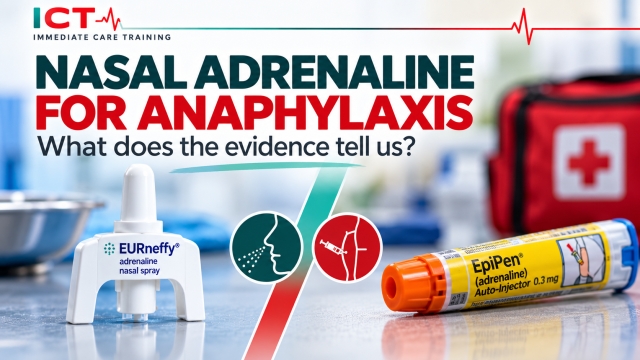
Nasal Adrenaline for Anaphylaxis: What Does the Evidence Tell Us?
4th October 2026
Brian Carlin
A needle-free option for adrenaline
The arrival of intranasal adrenaline represents an important development in the emergency treatment of anaphylaxis. EURneffy is a single-dose adrenaline nasal spray authorised in the European Union for the emergency treatment of allergic reactions, including anaphylaxis.
What does the latest evidence tell us?
A recent Best Evidence Topic published in the Emergency Medicine Journal examined an important clinical question: is intranasal adrenaline as effective as intramuscular adrenaline in the treatment of anaphylaxis?
The review found promising evidence for intranasal adrenaline but concluded that there is currently insufficient clinical evidence to determine whether it is as effective as intramuscular adrenaline during anaphylaxis.
This distinction is important. Regulatory approval of a new method of administering adrenaline does not necessarily mean that existing clinical guidelines immediately change.
What do current guidelines say?
For healthcare professionals, intramuscular adrenaline remains central to current anaphylaxis management guidance. Resuscitation Council UK recommends giving IM adrenaline promptly when anaphylaxis is recognised, with further IM adrenaline after 5 minutes if airway, breathing or circulation problems persist.
What does this mean for clinical practice and training?
Healthcare professionals are increasingly likely to encounter patients carrying newer adrenaline delivery devices. Training therefore needs to evolve alongside these developments.
Clinicians should understand how newer devices are used while also remaining familiar with current emergency treatment guidelines, appropriate IM adrenaline dosing and the importance of giving adrenaline without unnecessary delay.
Teaching Point
New routes of adrenaline administration should be incorporated into anaphylaxis education, but it is important to distinguish between regulatory approval, emerging clinical evidence and current treatment guidelines.
Further reading
European Medicines Agency: EURneffy.Resuscitation Council UK: Special Circumstances Guidelines – Anaphylaxis.
Recent articles
